
As our country celebrates 250 years of independence, I’ve been thinking about freedom. For accountants, freedom often looks like one thing: “If I could just quit my job and start my own firm, I’d finally be free.” Having founded and led three companies, I’ve learned that’s only partially true. Yes, entrepreneurship gives you more flexibility, more ownership, more control over your schedule. But it doesn’t automatically give you freedom.
In fact, for many new firm owners, the feeling of freedom is temporary. The relief of leaving your job is real. Then reality sets in. No one tells you what to work on. No one sets your priorities. No one creates accountability. Ironically, the very structure that once felt restrictive is suddenly gone. Without replacing it with your own systems, rhythms, and disciplines, it’s easy to stay incredibly busy while accomplishing very little. Momentum slows. Revenue becomes inconsistent. Stress quietly returns.
Over the years, I’ve come to believe something that sounds completely backwards: freedom isn’t found by escaping structure. It’s found by designing it. That is one of entrepreneurship’s greatest gifts, not the absence of structure, but the ability to create your own.
For example, I almost never start my workweek on Monday. Years in public accounting and corporate finance conditioned me to dread Sunday evenings, because Monday represented a week I didn’t control. Even today, I smile a little when I begin my week on Tuesday. It still feels like I’m getting away with something. My structure doesn’t have to look like anyone else’s. That’s freedom.
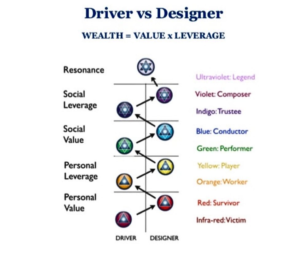
“Driver” gives you freedom of choice and “Designer” gives you freedom of movement.
Roger James Hamilton, one of my mentors, teaches that as you move up the wealth spectrum, every level requires a trade.
As an employee (orange: worker), you enjoy freedom of choice, but you have very little freedom of movement. Someone else determines where your time goes. When you become self employed (yellow: player), everything flips. Suddenly you have tremendous freedom of movement. You decide when to work, where to work, and what to build. But there’s a cost. You have to surrender much of your freedom of choice. The work that needs to be done doesn’t care what you feel like doing that day. The client deadline still exists. Payroll still has to be met. Marketing still has to happen. You don’t get to choose only the work you enjoy.
This is where many people get stuck. They want the freedom of movement that comes with owning a firm, while holding on to the freedom of choice they had as an employee. Those two don’t coexist for very long. Without accepting that trade, many entrepreneurs struggle, lose momentum, and eventually decide a job was actually easier.
As you continue moving up the wealth spectrum and build a firm (green: performer) with systems and a great team, something interesting happens. You give up some freedom of movement again. You have responsibilities to your team. You can’t disappear whenever you want. But in exchange, your freedom of choice returns. You gain the ability to choose where you create value, which clients you serve, which opportunities you pursue, how you spend your time.
Freedom isn’t a destination. It’s a dance. Every level requires letting go of one kind of freedom to gain another. I think about freedom the same way I think about profit. Profit creates options. Freedom does too. The question isn’t whether you have freedom. The question is whether you’re holding on to yesterday’s version of freedom while trying to build tomorrow’s life.
As we celebrate 250 years of independence, here’s a question worth asking yourself: what do you need to let go of in order to move up? Because sometimes the very thing you’re trying to hold on to is the thing preventing you from becoming the person you’re capable of becoming.